Operating Room Equipment: A Practical Buyer’s Guide
An operating room is planned as a set of equipment categories, not a fixed package. Room function, layout and workflow decide what each project needs, and ICU planning runs alongside the operating room list as a separate exercise.
Planning an OR Project: Room Function, Layout and Workflow
Planning operating room equipment starts with the procedures a room will host, because that decision sets the table size, the light reach, and the room services the space must carry. The main categories are surgical lights, operating tables, medical pendants, electrosurgical units, patient monitors, pneumatic tourniquets, stretchers, and the room furniture that supports circulation. Each category is specified on its own, then checked against the room drawing before a project order is placed.
Selection factors follow the room rather than a catalogue. A general theatre, an orthopedic room, an ophthalmic room and a day-surgery room each place different demands on table articulation, light positioning and pendant coverage. Layout decides where ceiling-mounted arms can travel and where floor space stays clear. Workflow decides what sits within the sterile field and what stays at the perimeter. Project scope decides whether a room is a new build, a replacement cycle or a phased upgrade, and the equipment schedule should be read against that scope.
Model-specific questions are best handled at quotation stage. Send the room schedule, the procedure mix and the quantities required for each room type, and Huifeng Medical will quote against current models and configurations.
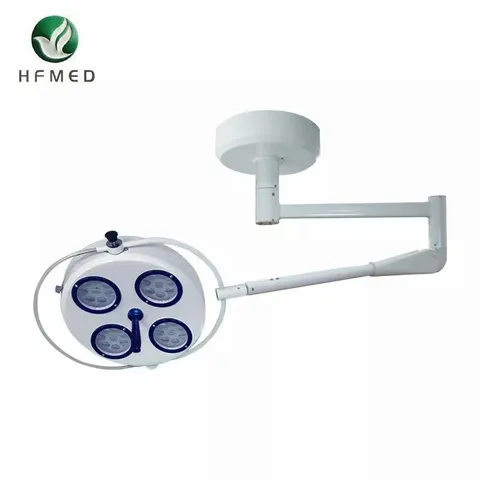
Single round head with four blue lenses 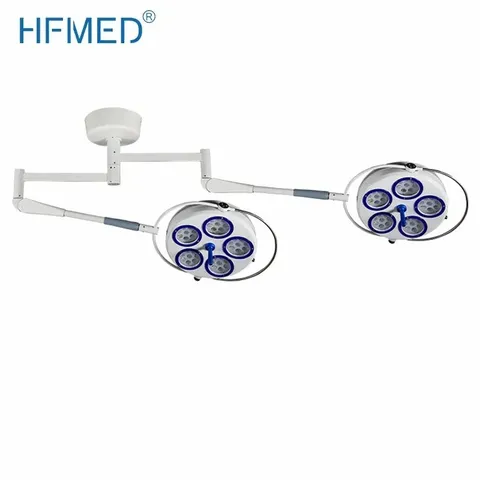
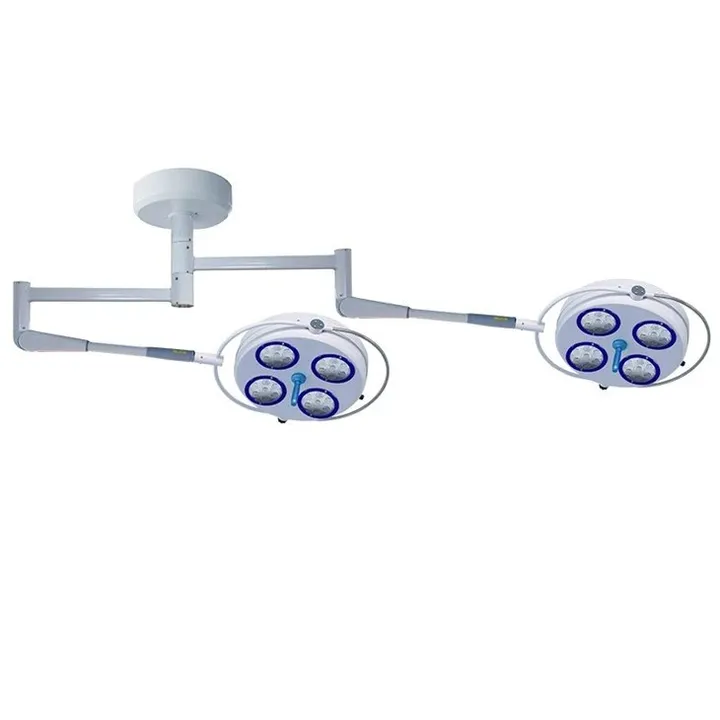
Twin ceiling-mounted heads with blue lenses
Operating Room Equipment Categories
A workable operating room equipment list is grouped by function rather than by supplier sequence. Grouping shows which items belong to the surgical field, which serve the room shell, and which support movement in and out of the room. It also makes quotations easier to compare line by line, because each group can be reviewed separately against the room drawing. The final list depends on room type, layout and project scope, and it changes as the drawing develops.
- Surgical field: surgical light, operating table and the accessories used with the table during a procedure.
- Procedure support: electrosurgical units, pneumatic tourniquets and patient monitors, sized to the room’s procedure mix.
- Room services: medical pendants that bring power, gas and data to the working area.
- Transport: stretchers used for transfer between ward, holding area and theatre.
- Room furniture: casework, carts, seating and waste points, coordinated with the room planner.
The list is a planning instrument, not a fixed bundle. Rooms of similar size can carry different lists once procedure mix and layout are taken into account. Multi-room projects usually start from a base list for the standard room and a variant list for specialised rooms.
ICU Room Equipment Planning
icu equipment is planned as a category of its own, separate from the operating room list, even when a project procures for both areas at the same time. The usual categories are ICU beds, air mattresses, patient monitors, bed head units and medical pendants. Planning depends on room layout, on how patients are moved and positioned at each bed space, and on the monitoring arrangement required there. The ICU schedule is therefore built bed position by bed position.
Keeping the ICU schedule apart from the theatre schedule helps contractors coordinate ceiling work, bed lift access and delivery routes. Bed head units and medical pendants are fixed to the room, so their positions are settled early in the drawing stage, while beds, mattresses and monitors follow room handover. Huifeng Medical supplies ICU beds, air mattresses, patient monitors, bed head units and medical pendants within these categories.
- Head-end services: bed head units and pendants set out with the bed layout.
- Monitoring: how patient monitors are mounted and read from the bed space.
- Bed surface: air mattresses specified together with the bed frame.
- Storage: consumables and equipment kept within reach of the bed space.
Ordering, Lead Time and OEM Options for OR Projects
Huifeng Medical was established in 1992 and became a joint-stock company in 2018. It runs 3 factories, each focused on a different product line, with above 10 production lines and more than 100 employees, and an R&D team of 11-20 people. More than 90% of production is exported, and sales cover more than 50 countries across North America, South America, Eastern Europe, Southeast Asia, Africa, Oceania, the Middle East, Eastern Asia and Western Europe. The company promotes the HFMED and SHANGYI brands.
Average lead time is within 15 working days in both peak and off seasons, with actual timing confirmed in each quotation. Accepted terms include L/C, T/T, PayPal, Western Union and MoneyGram, and Incoterms include FOB, CFR, CIF, DAP, DDP, FCA and EXW. OEM and ODM work is available alongside the HFMED brand, with terms confirmed in the quotation.
The usual sequence is straightforward. The buyer sends an equipment list with quantities and room types, Huifeng Medical replies with a quotation, production follows, goods are inspected and packed, and shipping is arranged against the agreed Incoterm. Project contractors working across theatre and ICU areas can combine the schedules in a single enquiry so that delivery windows line up with the site programme.
Request a quotation
Describe your operating room, ICU or ward project and the equipment list, and we will reply with matching models and a quotation.
Or write to sales@surgicallightmanufacturer.com